
Are you tired of dropped calls and frustrating disconnections? Discover the best cell phone signal boosters that overcome weak reception in just minutes. Enjoy improved call quality with advanced cell signal amplifiers and powerful mobile network extenders designed to keep you effortlessly connected. Embrace our trustworthy guide and experience a life-changing boost that fills you with incredible relief and joy. Let’s dive into how these solutions can transform your mobile connectivity.
Contents
- Top 5 Cell Phone Signal Boosters:
- 1. weBoost Home MultiRoom – Best Cell Phone Signal Booster Overall
- 2. HiBoost Cell Booster – Best Cell Phone Signal Booster for Large Homes
- 3. SureCall Fusion4Home – Best Cell Phone Signal Booster for Medium Sized Homes
- 4. SureCall Flare 3.0 – Best Cell Phone Signal Booster for Apartments
- 5. Amazboost Cell Booster – Best Budget Cell Phone Signal Booster
- Things to Consider Before Buying a Cell Phone Signal Booster:
- Measuring Your Signal at Different Locations
- Understanding Coverage Maps
- Determining the Size of Your Space
- Analyzing Usage Areas: Home, Office, Vehicles
- Mounting Options and Equipment Needs
- Comparing Warranties and Warranty Lengths
- Final Words
Top 5 Cell Phone Signal Boosters:
1. weBoost Home MultiRoom – Best Cell Phone Signal Booster Overall

If you constantly struggle with bad reception at home, then weBoost’s Home MultiRoom is the answer for you. Built to significantly increase your cellular signal and enhance your coverage, this kit will allow you to get maximum bars on your phone in 3-4 rooms or up to 5,000 sq. ft. You won’t have to be dealing with dropped calls or slow internet in your frustrated home anymore!
An important selling point of the weBoost Home MultiRoom is that it supports all carrier networks, allowing you to boost your signal strength for all of your devices, no matter your carrier, without incurring any added cost. It simply attaches to your other wireless plan, for a simple, affordable way to get into easier communication.
Installation made easy: the signal booster is attached using a 3-step installation, providing easy-to-follow instructions that help you easily get everything set up in a few minutes. You can even locate the closest cell tower, compare signal, and get great improvements in signal quality just by learning how to tilt the antenna.
The package also includes all needed components: an outside directional antenna, the Home MultiRoom booster, a fabric inside panel antenna, and a power supply, as well as the needed cables and mounting hardware. With this complete setup, you’ll be sure to have everything you need for a strengthened signal, and a connected, efficient home. Don’t let spotty signal put an end to your most important calls! boost your signal and max your connections for faster internet, consistent service, and clear calls with weBoost.
2. HiBoost Cell Booster – Best Cell Phone Signal Booster for Large Homes

If you find yourself getting frustrated of dropped cell phone calls, stuck text messages, and slowing data speed, because your home on the edge of cell phone reception and you have to run into next room to take a call. This mighty booster is very much capable of supporting coverage area of 6, 000 sq. ft. coverage (open to multiple rooms – up to 3-4 rooms). With up to +65 dB gain, it works for better voice and data performance. This booster will keep you in the loop – whether you’re at home, in the office, on the road, or in a cabin or garage.
Installation is meant to be simple. With a brilliant LCD screen, as well as an exclusive app called “Signal Supervisor” integrated in, you can install the booster and check up on its status from the comfort of your smartphone. There’s also real-time updates, in-depth installation instructions and live chat support, if you need help with anything — meaning the process is easy.
This HiBoost booster works with all carriers to give you crystal-clear calls and lightning-fast service for all those using your space. There’s no need for additional indoor antennas, and the signal booster is easy to install, allowing you to stay connected and making your bars go up. Why choose HiBoost? HiBoost is a trusted brand from USA and the Hiboost Cell Phone Signal Booster is a reliable and easy to use device that boosts signal and reduces dropped calls. Stay connected, reduce annoyances, and experience clear chats and music without interruption.
3. SureCall Fusion4Home – Best Cell Phone Signal Booster for Medium Sized Homes

Are you tired of poor cellular coverage? If so, and you live in a medium-sized home, then the SureCall Fusion4Home Yagi/Whip signal booster may be the answer to your struggles. Engineered for rural and suburban areas, this product will improve your voice quality and 4G LTE and 4G data on all devices, making all of your wireless connections faster.
One notable feature of the Fusion4Home is it works with all 5G phones. This translates into better call quality and faster data speeds even as it evolves with incoming technology. It’s a large area booster that reaches up to 3,000 square feet, getting rid of your poor call quality and slow internet.
Installation is simply, so just about anybody can use it. Just install the outdoor yagi-directional antenna, run the coax cable into your home, place the cellular amplifier — it’s your “base unit” — wherever you’d like a stronger signal. Finally,join the whip antenna with the amplifier all is done.You can have a significant improvement on data transmission.
The longevity of the SureCall Fusion4Home is also a core element. Weatherproof outside antenna is included with this booster system; it simply attaches to the N-Type connector to the bottom of the signal amplifier. Boost your satisfaction with the SureCall Fusion4Home, and boost the productivity you rely on for work, streaming and more, that comes with clear calls and faster, more consistent data downloading. Be there when it counts.
4. SureCall Flare 3.0 – Best Cell Phone Signal Booster for Apartments
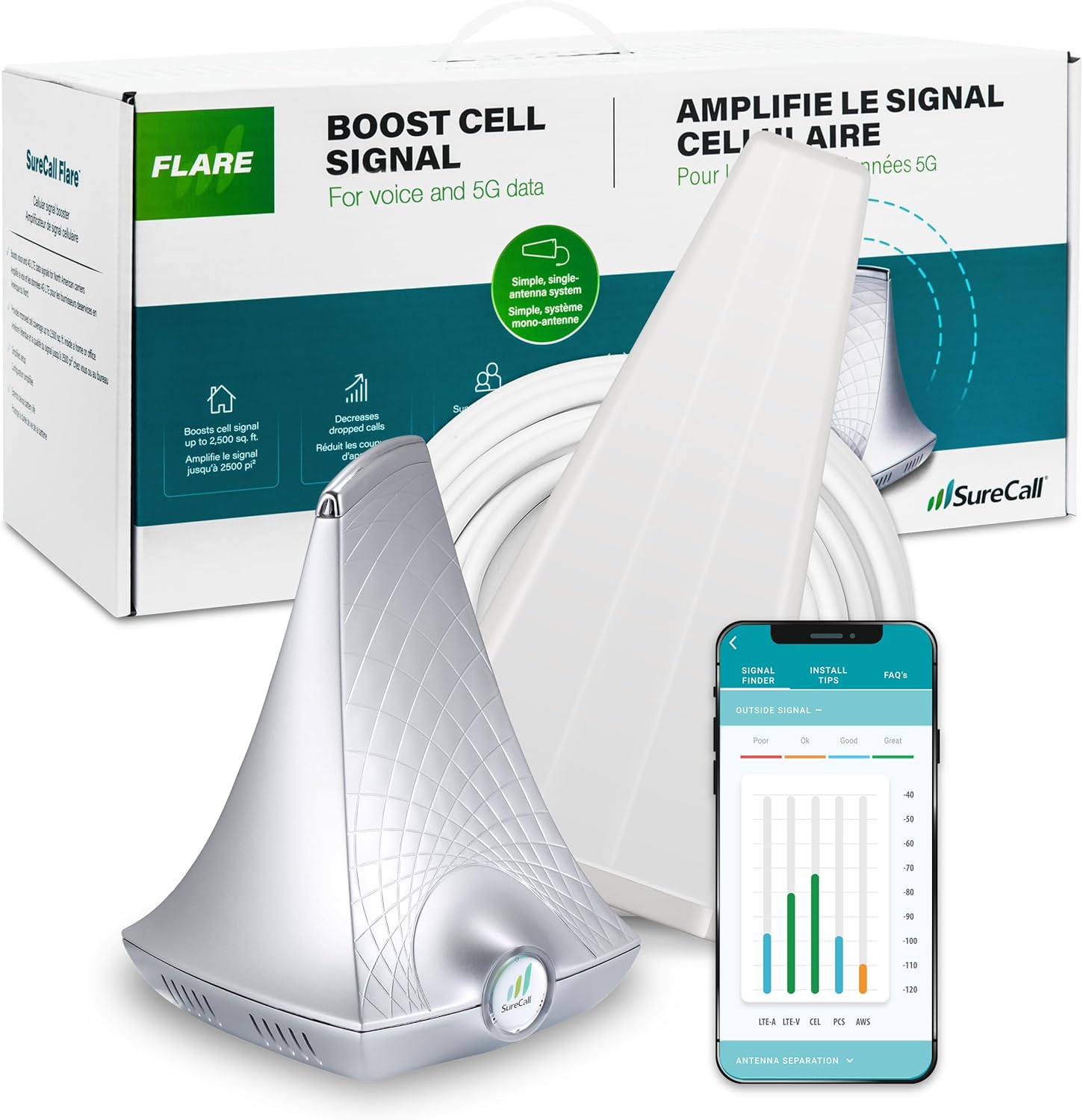
If there’s one thing that we still can’t live without, it’s our cell phone, and the SureCall Flare 3.0 cell phone signal booster is a great way to increase the signal in your appartment when it’s weak. Built to cover large homes and medium office’s, this model has been designed to amplify weak signals in 2-4 rooms and can cover up to 3,500 square feet, based on the strength of the existing signal.
Knowing how this tool functions can be advantageous. The coverage can be increased by adding multiple Indoor antennas. For example, if you have 1–2 bars of outdoor signal, then you can anticipate about 1,500 square feet of coverage indoors. On the other hand, with 5 bars outside, that coverage can reach a whopping 3,500 square feet. For best results, you will want to place the Yagi on the highest point available like the roof of your cabin to be able to grab the most signal possible, and at least 30 feet or more away from the base unit and the outside antenna.
Installation is a breeze – simply mount the outdoor Yagi antenna onto your roof, run the coaxial cable into your home, and connect the amplifier to your tuner to receive Free local and network TV. Flare 3.0 is designed to integrate seamlessly into your environment, making it easy to stay connected on the go. Experience crystal clear phone calls and lightning fast data speeds- all in your space with this powerhouse signal booster.
5. Amazboost Cell Booster – Best Budget Cell Phone Signal Booster

If you find yourself with bad phone signal at the home in a cell phone dead zone, then the Amazboost Cell Booster might just be the fix you’ve been seeking. Engineered to boost your signal up to 100 times, this low-cost booster covers an area of up to 2,500 square feet. It effectively eliminates dropped calls, increases voice clarity and data speeds, making the cell phone experience a more fulfilling one.
But keep in mind that the Amazboost doesn’t work well for apartments, trucks and RVs and it will only work if the outside signal is stronger than -110 dBm. Please check the connectivity in the location where you plan to purchase prior to buying.
The Amazboost Cell Booster on the other hand is an easy DIY install. It’s one of two satellite-based providers in the US — and one of the biggest in the world — so be prepared for roof installation and cables running into your home’s walls, but most people can get everything setup in 1-2 hours. Just make sure to read the instructions carefully so that installation goes smoothly.
If there are tall trees within 100 feet of your home, how you position the outdoor antenna is crucial — ideally up high (at least 60 to 80% of the tree’s height), to maintain a strong signal.
No monthly bills, no monthly fees, no contract! The Amazboost is a novel intelligent booster built to cover your entire home or office, use multiple device at the same time. Reliable, consistent service to stay connected with the people who matter most.
Things to Consider Before Buying a Cell Phone Signal Booster:
You want to improve your cell phone reception, but choosing the right signal booster can be challenging. Before making a purchase, you need to evaluate factors like compatibility with your carrier, the size of your coverage area, and installation requirements. Understanding signal strength and regulatory guidelines will also help you select an effective and compliant booster. This guide will help you make an informed decision that enhances your connectivity without unnecessary expense or hassle.
Measuring Your Signal at Different Locations
Signal strength can vary widely within a single building or its surroundings, so map your reception at various points—near windows, in basements, or inside rooms with thick walls. Use your phone’s field test mode or specialized apps to record readings on each floor or corner. Noting these variations highlights where interference is worst and guides optimal booster placement. Sometimes, a single weak spot drags down the entire home’s connectivity; identifying that spot ensures your booster installation maximizes coverage improvement.
Understanding Coverage Maps
Carrier coverage maps provide a broad overview of expected signal strength across regions, helping you confirm whether your location falls within a service area. These maps combine data from cell towers, terrain, and population density to highlight strong and weak zones. However, expect discrepancies in indoor conditions since maps mainly reflect outdoor coverage. Comparing multiple carriers’ maps can reveal better options in your vicinity, useful if you’re considering a booster that supports several networks or contemplating a carrier switch.
Diving deeper into coverage maps reveals the methodology behind their predictions. They rely on radio frequency propagation models that factor in geography and building materials but may not capture real-time variations caused by new constructions or temporary obstructions. Evaluating recent customer feedback and local cell tower upgrades alongside coverage maps provides a more accurate picture. Some third-party sites, like CellMapper, offer crowdsourced signal data to cross-verify official maps, helping you make a more informed decision about signal boosting needs.
Determining the Size of Your Space
Calculating the total square footage requiring a stronger signal guides your choice of booster. For instance, a 500 sq ft apartment might only need a 1,000 sq ft capacity booster, while a multi-level office with over 5,000 sq ft demands a high-gain system. Remember to factor in attenuation by thick walls or metallic structures, as these can limit effective coverage despite the booster’s rated capacity.
Analyzing Usage Areas: Home, Office, Vehicles
Usage varies significantly between stationary spaces like homes and offices versus vehicles where mobility and external interference complicate coverage. A home booster may prioritize reliable indoor signal strength, while a vehicle booster must handle signal fluctuations on the move. Offices often require multi-device support across shared areas, so you might opt for a commercial-grade booster designed for crowded environments.
Delving deeper, your home setup usually demands a balance between coverage size and simplicity, often benefiting from plug-and-play devices that enhance basement or attic reception. Offices often encounter denser populations and more electronic interference, making commercial boosters with higher gain and multiple antenna installations necessary to maintain consistent signal quality throughout various rooms or floors. In contrast, vehicle boosters must handle rapid signal changes caused by movement, requiring rugged designs with specialized antennas tuned for both urban and rural driving conditions. Your chosen booster should match these specific activity profiles to avoid dead zones during critical moments.
Mounting Options and Equipment Needs
Outdoor antennas typically mount on rooftops, poles, or exterior walls, requiring sturdy brackets and weatherproofing materials. Indoor antennas might sit on flat surfaces or be mounted on walls with adhesive or screws. Your choice depends heavily on building type, material, and where the existing signal strength is highest. Longer coaxial cables grant more flexibility for antenna positioning but can slightly reduce signal quality due to attenuation. Matching cable quality and length to your layout ensures optimal performance.
For example, if you live in a multi-story home with mixed drywall and brick walls, you might choose a rooftop antenna secured with a galvanized steel pole and heavy-duty mount to withstand winds, paired with low-loss coaxial cable to maintain signal integrity over longer distances. Indoor antennas could be strategically placed on each floor to provide balanced coverage. Including surge protectors and grounding equipment protects your investment from lightning strikes and electrical surges, especially critical in exposed mounting installations.
Comparing Warranties and Warranty Lengths
A longer warranty often indicates manufacturer confidence and includes repair or replacement against defects but may exclude damage from improper installation or external factors. Carefully review warranty terms to understand what’s covered and consider how support responsiveness aligns with your expectations.
Final Words
Drawing together the key points, before buying a cell phone signal booster, you should evaluate your specific signal needs, check compatibility with your carrier and device, and consider the booster’s range and installation requirements. Ensuring it meets local regulations and avoids interference is also important. By thoughtfully assessing these factors, you can choose a booster that effectively enhances your connectivity and provides a reliable mobile experience tailored to your environment.
Leave a Reply