
Finding the best dash cams provides the ultimate peace of mind for any driver. That gut-wrenching feeling after an accident, worrying about proving your innocence, can be a thing of the past. A reliable car camera acts as your silent, unbiased witness, capturing crucial footage to protect you from false claims and insurance headaches. We’ve rigorously tested and reviewed the top models to make your decision easy. Let’s explore the cameras that will keep you safe and secure.
Contents
- Top 5 Dash Cams:
- 1. Vantrue N4 – Best Dash Cam Overall
- 2. Vantrue N2 Pro – Best Dash Cam for Rideshare Drivers
- 3. WOLFBOX G840S – Best Rearview-Mirror Style Dash Cam
- 4. Rove R2-4K Pro – Best Dash Cam for 4K Video
- 5. Garmin Mini 2 – Best Budget Dash Cam
- Things to Consider Before Buying a Dash Cam:
- Front-Facing Dash Cams
- Dual-Channel Dash Cams
- Video Quality
- Storage Capacity
- Drawbacks to Consider
- Researching Brands
- Reading Reviews
- Finding the Ideal Location
- Regular Updates
- Cleaning the Lens
- Conclusion
Top 5 Dash Cams:
1. Vantrue N4 – Best Dash Cam Overall
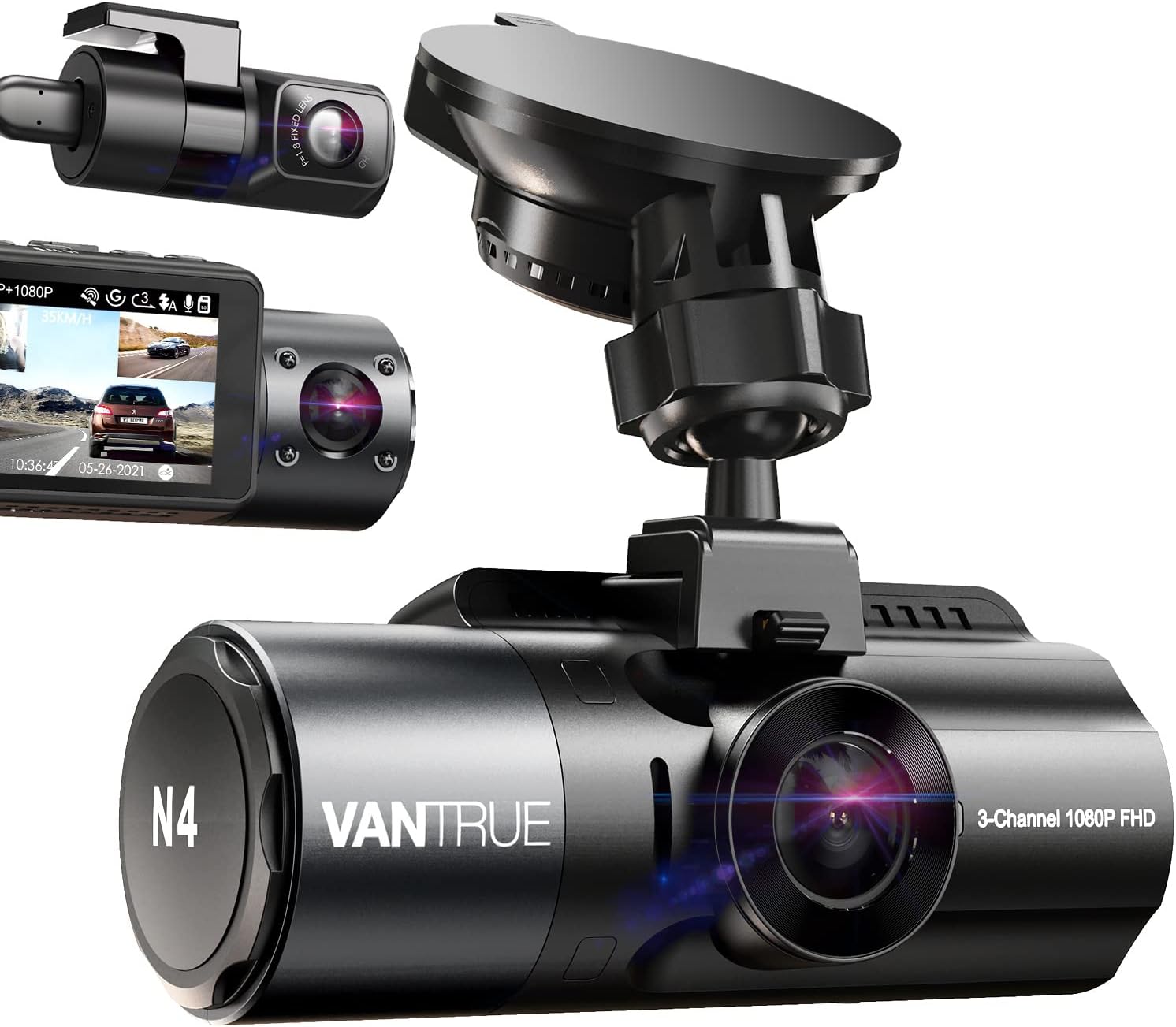
The Vantrue N4 is designed to be a no-frills, silent partner in your vehicle, providing full-coverage recording. A three-camera setup cameras the front of the road, the cabin, and the rear, covering more angles when the unexpected occurs. In which case, the front camera provides critical detail with 2560 × 2160 resolution for license plates and signs.
However, operating all three and maintaining high quality is feasible—the front video at 2560 × 1440 resolution. The cabin and rear cameras capture 1920 × 1080, achieving a balance between resolution and coverage in everyday driving, road trips, school runs, and more. Overnight, you can count on high-quality performance as well.
For recording in low-light environments, the cabin camera uses infrared illumination, such as nighttime driving, rideshare, or poorly lit parking garages. Furthermore, whenever your vehicle is in use or you are away from it, collision and motion detection protect your investment. The cameras can capture accidents while recording, providing you with additional context when someone bumps or moves their car.
When it comes to storage, there’s less than that: you can tape for about 6.7 hours continuously on a 128 GB microSD card before old videos are erased, giving you more peace of mind. If you want sharp video, broad coverage, and consistent features that support you rather than distract you, the N4 is a solid pick for regular drivers, road trips, and everyone else who anxiously wants evidence.

If you’re in the market for a reliable dual-camera dash cam that’s invisible from the outside, the Vantrue N2 Pro captures both the road and what’s inside your car in 1080p without blocking your windshield. Its tiny body doesn’t obstruct your field of vision, so you can focus on the road.
You receive the core protections you need. A built-in G-sensor can sense a collision and lock the clip virtually immediately, while Parking Mode wakes the camera if it detects motion or vibration on or around your vehicle—great for street parking, overnight stays, or rideshare wait time. Loop recording automatically keeps your newest footage rolling, without the need to manually clean out space.
Operation is straightforward. Though the physical buttons are on the small side and there is no advanced driver-assist suite, the menus are easy to use and responsive.
You can tilt the interior camera to capture the cabin from your desired angle — useful for rideshare recording or just checking in on a teen driver. Time-lapse mode compresses long drives into minutes-long videos, so you can relive or share a day on the road in no time.
You have the assurance to map every mile — while also having fuel details and credit card information at your fingertips, without paying for what you don’t need so that you can focus on the parts of your trip that mean the most to you.
3. WOLFBOX G840S – Best Rearview-Mirror Style Dash Cam

If you’re in the market for a dash cam mirror with extended visibility and limited distractions while driving, the WOLFBOX G840S offers a cleaner view of the road ahead and clearer evidence. It attaches to your existing mirror, and instead of you know waving off that glare, offers up a crisp 12” touchscreen (1.5× the size of most inbuilt mirrors) which shows what’s behind/next to you when driving or reversing.
Off the front, you’ll shoot in 4K UHD (2160p) with a 1080p rear co-pilot to offer full-time coverage. A 170° front lens and 140° back lens expand what you can see, and the intelligent split-screen empowers you to observe them simultaneously. Reverse Assist overlays parking help lines onto the screen to assist in parallel parking, etc., and the 2.5D center panel is designed to complement your car interior.
Clarity stands strong in difficult light. The enhanced anti-glare LCD minimizes reflections during the day, and WDR and HDR adjust for bright light and heavy shadows at night. It has a professional-grade sensor and 6-glass lens that keeps plates readable, scene details sharp even in rain, dusk or oncoming headlights.
Temporal protection is automatic: G-sensor event locking, loop recording, Parking Monitor.Mobile App Control The V6 has all the core protections while driving automatically in place, such as Loop recording, parking monitor and G-Sensor. Usb powered and featuring a black design with rearview-mirror mount, this driving clip recorder comes loaded with features to keep you safe every time you hit the road—always ensuring clear footage of accidents at the ready.
4. Rove R2-4K Pro – Best Dash Cam for 4K Video

If you’re in the market for a dash cam that will enhance your commute, without making it overly complicated, the Rove R2-4K Pro produces sharp 4K video and is an installation you can complete in minutes. Slap a microSD card in, clip it on and power up, then you’re recording – no learning curve or fiddly menus.
You get clarity in all the right places. Professional quality video recording With 4K resolution, vibrations of your route are removed; license plates, traffic signs and scenery is more easily identifiable providing you with the best evidence The interface eschews a touch screen in favor of direct buttons and clear menus, so you will be able to adjust settings quickly and keep your eyes where they belong: on the road.
Staying connected is easy. Dual-band Wi-Fi and built-in GPS allow you to move clips from the camera to your phone, add location and speed data and share highlights or protect what happened. And a companion app makes it easy to review, download and manage footage (which can be helpful for insurance claims or just reminiscing about a great drive).
Small and professional installation:Despite of its compact size, the R2-4K Pro can still be hidden behind the rear view mirror so that you won’t take up too much space on your windshield or blocking your line of sight. If you value solid recording, clean video and controls that aren’t in your way, this tiny cam is the right fit for you ready to capture chaos or charm on the every day road so you can drive with confidence.
5. Garmin Mini 2 – Best Budget Dash Cam

The Garmin Dash Cam Mini 2 is for you if you want a camera that doesn’t draw attention to itself and simply works. It fits comfortably out of sight behind your rear-view mirror, adding no extra clutter to your windshield while still being able to save the most vital footage. You’ll get clear and precise video: Full HD 1080p at 30 fps with HDR helps you to capture fantastic images and see what’s happening around you.
With glare, shadows, and difficult light amounts—from sunrises to sunsets—you can still take pictures and make license plates and road markings readable whenever it is most essential. Installation is a snap. The small mount keeps the size small, and the ball-and-socket joint enables you to set the ideal angle in seconds. There’s no need to distract yourself by looking at your camera’s screen. Simple shortcut clicks enable you to save an essential event or shut off the microphone with a single tap.
The Garmin Drive app, on the other hand, puts control into your hands by allowing you to make adjustments, watch video, and arrange clips all at once on your phone.. It’s devoid of built-in GPS, making it the ideal size and easy-to-use camera, ideal for your entire windshield, for good footage. Simply power up, adjust your angle and begin recording— your everyday trips and moments are saved with simple explanations as you concentrate on the rest of the drive.
Things to Consider Before Buying a Dash Cam:
Dashcam selection affects your safety and evidence in incidents, so you should evaluate video resolution and night performance, field of view, mounting and power options, storage and loop recording, GPS/connectivity, parking modes, reliability, and warranty to match your driving needs and budget.
Front-Facing Dash Cams
Most front-only units offer 1080p at 30–60 fps, some provide 2K or 4K for clearer plate reads at distance; you should check FOV (120°–160°) and low-light performance—Sony STARVIS sensors often improve night capture—and confirm loop recording, G-sensor impact-lock, and optional GPS logging fit your evidence needs.
Dual-Channel Dash Cams
Dual-channel systems pair a front camera with a rear camera (common combos: 4K front + 1080p rear or 1080p/1080p), providing synchronized timestamps and parking mode for both angles; you’ll gain rear-collision evidence and better coverage for hit-and-run or vandalism claims.
Wiring choices matter: hardwire kits enable full parking surveillance without draining your battery, while cigarette-adapter setups are simpler but limit parking mode runtime. Use U3-rated microSD cards and consider 64–256GB capacity depending on resolution and loop length. Mount the rear camera high on the rear glass for unobstructed views, and note higher bitrates (and 4K recording) increase storage and heat—models like BlackVue DR900S‑2CH illustrate tradeoffs with 4K front clarity versus larger file sizes.
Video Quality
Prioritize at least 1080p (Full HD) to read plates at 10–20 meters; 4K improves distant-detail capture and cropping but increases storage and processing needs. Look for 30–60fps depending on motion—60fps smooths highway incidents—plus HDR/WDR to handle glare. You should choose cameras with proven sensors (e.g., Sony STARVIS) for better nighttime performance and sample footage from reviews before buying.
Storage Capacity
Pick microSD sizes based on resolution and desired retention: 32GB holds roughly 3–4 hours at 1080p/30fps, 64GB about 6–9 hours, while 128–256GB suits 4K or extended parking mode. Opt for Class 10/U3 cards from SanDisk or Samsung and enable loop overwrite to prevent gaps. You should balance card cost against how many hours you want archived.
Understand bitrate: typical 1080p/30fps runs ~8–16 Mbps so a 64GB card stores ~9–17 hours; 4K/30fps often uses 40–60 Mbps, reducing storage to ~2–4 hours on the same card. Choose high-endurance cards rated for continuous write cycles and check MTBF/endurance specs; format in-camera periodically and plan backups, replacing cards every 1–3 years depending on write volume.
Drawbacks to Consider
You face potential legal limits on audio recording and windshield obstruction, along with ongoing costs for high-end models and replacement microSD cards; continuous recording also raises privacy questions in shared or commercial vehicles. Heat exposure in parked cars shortens device lifespan, and poor mounting angles or heavy compression can render footage unusable for plate identification.
Digging deeper, you should verify local laws about in-car cameras and audio capture—some jurisdictions require driver consent for recordings. Installations that draw power from the accessory port can drain batteries during extended parking mode without a voltage-cutoff hardwire. For chain-of-custody use in court, maintain original files and consider cameras that support file integrity features (checksum or automatic cloud upload) to prevent tampering claims.
Researching Brands
Evaluate established makers like BlackVue (DR900X), Thinkware (U1000), Nextbase, and Vantrue so you can compare firmware update cadence, cloud features, and parking‑mode reliability. Prioritize brands that publish regular firmware updates and post changelogs so you know issues are being fixed.
Reading Reviews
Scan reviews for real video uploads—day, night, and parking‑mode clips show true performance; give more weight to verified purchases and reviewers who note firmware versions and test conditions. Watch for repeated reports of overheating, loop‑recording failures, or corrupted files across 10–20+ reviews rather than isolated praise, and value reviewer comparisons that show identical conditions.
Dive into community threads on Reddit (r/Dashcam) and dedicated forums to spot aggregated failure patterns, then watch YouTube sample clips at your planned resolution/frame rate; compare bitrate or file sizes—4K clips often range 30–60 Mbps while 1080p typically sits 8–20 Mbps, which affects plate legibility at distance. Check seller return policies and whether the vendor issues firmware patches for reported bugs so you can update or return if issues arise.
Finding the Ideal Location
Place the camera centered behind the rearview mirror so your windshield view stays clear and the field of view (typically 120–160°) captures both lanes; set the lens about 1.5–3 cm below the mirror top to avoid sunshade interference while keeping the horizon near the upper third of frame. Confirm no ADAS sensors or toll transponders are blocked, then record a short clip to verify license plates are legible at ~10–15 meters and glare is minimal.
Regular Updates
Check for firmware updates monthly or at least quarterly—manufacturers like BlackVue and Thinkware often release fixes and parking-mode improvements. Download updates via the vendor app or SD card and always back up your settings before flashing. Updates commonly address GPS drift, reduce false motion events, and improve temperature management, so staying current helps ensure your recordings are reliable when you need them.
Cleaning the Lens
Clean the lens weekly or after dusty, salty, or winter drives to prevent glare and soft images. You should use a clean microfiber cloth with a few drops of lens cleaner or 70% isopropyl on the cloth and wipe in gentle circular motions; avoid paper towels and household sprays. Never spray liquid directly onto the lens or housing seals—apply to the cloth first to limit moisture ingress.
Turn the camera off and, if removable, detach it before detailed cleaning. You can use a bulb blower or canned air from about 10–15 cm to dislodge grit, then inspect under bright light for scratches or haze; minor abrasions may be polished with a dedicated plastic polish, but deep scratches usually mean replacing the cover.
Conclusion
As a reminder, when choosing a dash cam you should evaluate video quality and night performance, field of view, mounting and power options, storage capacity and loop recording, parking/incident detection, GPS and connectivity, build reliability, and local legal requirements so your device reliably captures evidence and fits your daily driving needs.
Leave a Reply