
Finding the best 65-inch TVs shouldn’t feel like a confusing chore. You deserve a stunning 4K resolution screen that makes every movie night feel truly breathtaking. Whether you crave an OLED for deep blacks or elite gaming performance, we’ve simplified the search for you. Our team compared the latest models to find the perfect balance of price and quality. Let’s explore the top picks that will instantly transform your living room.
Contents
- Top 7 65-Inch TVs:
- 7: Hisense 65″ U6 Series Mini-LED 4K UHD Smart Fire TV (65U65QF)
- 6: TCL 65″ Class QM6K Series Mini LED QLED 4K HDR Smart Google TV (65QM6K)
- 5: TCL 65″ Class QM7K Series Mini LED QLED 4K HDR Smart Google TV (65QM7K)
- 4: Hisense 65″ U8 Series ULED Mini-LED 4K UHD Smart Google TV (65U8QG)
- 3: TCL 65″ Class QM8K Series Mini LED QLED 4K HDR Smart Google TV (65QM8K)
- 2: LG 65″ Class OLED evo AI 4K C5 Series Smart TV (OLED65C5PUA)
- 1: Samsung 65″ Class OLED S95F 4K Glare Free Smart TV (QN65S95FAFXZA)
- Things to Consider Before Buying a 65-Inch TV:
- Resolution Requirements and Refresh Rates for Motion
- Assessing HDR Formats and Integrated Sound Systems
- Advantages of Immersive Large-Screen Viewing
- Potential Limitations in Smaller Living Spaces
- Selecting the Right Smart TV Operating System
- Future-Proofing with HDMI 2.1 and Wireless Standards
- Determining Ideal Viewing Distance and Eye Level
- Safe Mounting Practices and Cable Management
- Input Lag and Variable Refresh Rate Support
- Motion Smoothing and Processing for Live Action
- Summing Up
Top 7 65-Inch TVs:
7: Hisense 65″ U6 Series Mini-LED 4K UHD Smart Fire TV (65U65QF)

When it comes to first-time 4K upgrades, the Hisense U6 is the greatest ultra-budget Mini LED.Every show seems flat and washed out because of your aging LED. To get the most bang for your buck, go with the U6.Up first, we have a mini-LED backlight that can reach a peak brightness of 1,000 nits and features 600 separate dimming zones. Superior darkness compared to standard LEDs.After that, we have a native 144 Hz display with AMD FreeSync Premium and Game Mode Pro. Effortless movement for video games and athletic events.
The last component is an integrated subwoofer that supports Dolby Atmos and Dolby Vision IQ. The sound of real bass, the look of true high dynamic range.Downside: there are only 600 fading zones, and some of them burst around light text. Ads are pushed by Fire TV. Not enough light for rooms that get a lot of sunshine.Recommended for: TVs in bedrooms and those looking to upgrade to 4K for the first time.Caution: intense gaming or extremely light environments.
6: TCL 65″ Class QM6K Series Mini LED QLED 4K HDR Smart Google TV (65QM6K)

The TCL QM6K is the most cost-effective and valuable step-up mini LED on the market.Not a flagship, but better than the entry-level option.In this case, the QM6K is ideal.To start, there’s a QD-Mini LED panel that uses quantum dot color and a Halo Control System to do away with the blooming problem that low-budget TVs generally have.After that, we’ll have AMD FreeSync Premium Pro and a 288Hz Game Accelerator working together at 144 Hz. This panel is super fast, even for console gamers.
The system concludes with an Onkyo 2.1 speaker setup that includes a subwoofer. Clear sound with deep bass—a soundbar is unnecessary.Downside: Sit head-on to get the best view. Stock mode is unrefined and needs some fine-tuning. Push advertisements in Google menus.Ideal for: living spaces on a tighter budget but nevertheless desire the latest Mini LED technology. Warning: interface purists and side-seat spectators may find this uncomfortable.
5: TCL 65″ Class QM7K Series Mini LED QLED 4K HDR Smart Google TV (65QM7K)
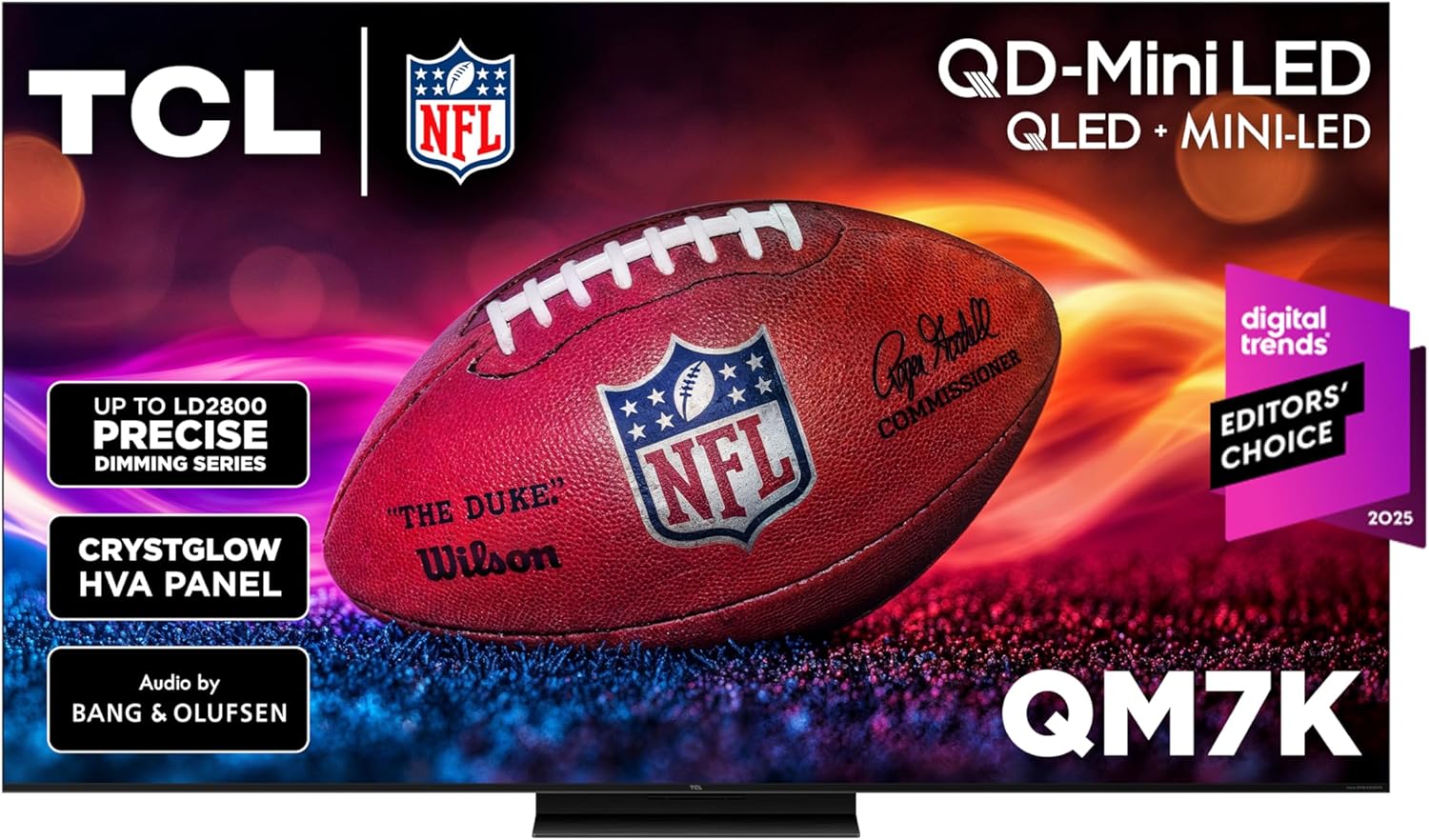
In terms of mid-range Mini LEDs, the TCL QM7K is your best bet for gaming and sports.With your previous TV, every fast-paced scene would have ghosting and muted colors. Each issue is resolved with the QM7K.The first is an LD2500-equipped QD-Mini LED panel. Precise Dimming and HDR 3000 peak brightness. Light and contrasty, like the sun.Up next: an AMD FreeSync Premium Pro and Game Accelerator 288-equipped 144Hz display. Compared to 60Hz TVs, PS5 and sports appear more fluid.
At last, there is Bang & Olufsen sound and a CrystGlow HVA anti-reflective panel. There is no longer any glare or tinny sound.Downside: the center seat offers the best view due to the narrow angle. The bass isn’t heavy on B&O. Feels like a cheap remote.Ideal for: homes with a focus on sports and gaming. Do not listen if you like a more minimalistic sound or have wide seats.
4: Hisense 65″ U8 Series ULED Mini-LED 4K UHD Smart Google TV (65U8QG)

For well-lit living spaces, nothing beats the Hisense U8QG Mini LED.Every afternoon, the view out your west-facing windows is ruined.Violent luminosity is the U8QG’s weapon of choice.The first is a Mini-LED Pro panel that can dim down to 5,600 zones with a maximum brightness of 5,000 nits. The most brilliant television here.Following that, the Hi-View AI Engine Pro CPU and a native 165Hz panel with VRR 288. Fluidity that is ideal for athletics and video games.
Last but not least: an integrated subwoofer and 4.1.2-channel audio system with Dolby Atmos speakers that fire upwards. Authentic 3D effects without the need for a soundbar.Regrettably, HDR10+ appears better, while Dolby Vision supposedly muted the bright. Evidence of fingerprints is revealed by the coating. Massive base.Ideal for: spaces with plenty of natural light and sports fans who desire cinema-quality sound. Beware: minimalist installations and purists of dark-room OLEDs.
3: TCL 65″ Class QM8K Series Mini LED QLED 4K HDR Smart Google TV (65QM8K)

The top-tier, OLED-competing mini-LED, the TCL QM8K.The deep blacks produced by OLEDs are unparalleled. With its Mini LED muscle, the QM8K comes incredibly near.The first is an LD3800-equipped QD-Mini LED panel. Accurate Dimming and a maximum brightness of 5,000 nits. Blooming is killed via halo control.Up next: an anti-reflective panel from CrystGlow with a wide-angle lens. Impressive for an LED screen, the image remains clear even when viewed from the side.
The 144 Hz screen, 288 Hz game accelerator, and Bang & Olufsen audio are the finishing touches. Sound and motion pack a powerful punch.Downside: OLED still has a better viewing angle. The two HDMI 2.1 connectors severely restrict the ability to set up several consoles.Push advertisements in Google menus.Ideal for: spaces with varying lighting conditions and those who value high-quality images.This is not for those who are rigidly tied to OLED displays or who play on four separate consoles.
2: LG 65″ Class OLED evo AI 4K C5 Series Smart TV (OLED65C5PUA)

As far as popular OLEDs go for living rooms in 2026, the LG C5 is your best bet.OLED was once considered too expensive. The C5 altered all that, as OLEDs became widely used.To start, there’s the Alpha 9 AI Processor Gen8 and an 8.3 million self-lit pixel OLED evo panel.Uniformly black. Color is spot on.Up next: support for NVIDIA G-Sync and AMD FreeSync Premium, a response time of 0.1ms, and 144Hz refresh rate. This is the best gaming setup available.
At long last: Bright Room Ready functionality, Dolby Vision, Dolby Atmos, and Filmmaker Mode. No lighting needed to see the movies in their original form.Despite taking precautions, a glossy screen will still reflect light in sunlight. No support for HDR10+. Here, brightness is second only to the most brilliant Mini LED.Ideal for: avid gamers and movie buffs. Those who aim for max brightness or accumulate HDR10+ will not be satisfied.
1: Samsung 65″ Class OLED S95F 4K Glare Free Smart TV (QN65S95FAFXZA)

In 2026, the most advanced 65-inch TV on this list—the Samsung S95F OLED—will be the best.OLEDs are notorious for two things: glare in bright environments and a tangled web of wires. Both issues are resolved with the S95F.A matte Glare-Free anti-reflective coating is applied to the QD-OLED panel first. Only one of these OLEDs can manage a brightly illuminated living room.The second component is an external Slim One Connect Box; each input is connected to its own box. A single, tiny wire is used to connect the TV.Thirdly, we have the NQ4 AI Gen3 Processor, OLED HDR Pro, and 165Hz refresh. This is Samsung’s most brilliant and color-true OLED display.
The fourth feature is Motion Xcelerator 164Hz, together with all three VRR formats and four HDMI 2.1 ports. All your gaming needs, both PC and console, met.Downside: Samsung has yet to include Dolby Vision. Setup procedures are enhanced with the Slim One Connect Box.It takes extra care to clean a matte covering.Ideal for: sleek, modern wall mounts and light-filled living areas. Dolby Vision collectors and thrifty consumers should look elsewhere.
Things to Consider Before Buying a 65-Inch TV:
You should assess various factors before purchasing a 65-inch TV. Screen resolution, viewing distance, and features like smart technology play significant roles in making the right choice. Understanding these aspects will enhance your viewing experience and ensure you select a model that best fits your needs.
Resolution Requirements and Refresh Rates for Motion
Choose a resolution that enhances clarity, especially for larger screens. Opt for 4K as a minimum standard, complemented by a higher refresh rate for smoother motion during fast scenes.
Assessing HDR Formats and Integrated Sound Systems
Investigate HDR formats supported by the TV, as they influence color accuracy and brightness. Integrated sound systems also play a key role in audio fidelity, often determining whether you need external speakers.
Exploring HDR formats can help you identify the best options for vivid colors and contrast. Some TVs support multiple HDR standards, such as HDR10, Dolby Vision, and HLG. Each format offers varying levels of brightness and color depth. Integrated sound systems should provide clear audio, but if you find the built-in speakers lacking, consider investing in an external soundbar or surround system to enhance your audio experience further.
Advantages of Immersive Large-Screen Viewing
Buying a 65-inch TV enhances your overall viewing experience, making content visually striking and engaging. Large screens provide an immersive environment perfect for action movies and gaming, allowing you to appreciate finer details, warm colors, and dynamic imaging.
Potential Limitations in Smaller Living Spaces
Fitting a 65-inch TV into a smaller living area can be challenging, leading to cramped spaces. Proper distance from the screen is important for optimal viewing, and a large TV may disrupt room flow, making it critical to assess your space beforehand.
In smaller living rooms, the sheer size of a 65-inch TV may dominate the space, making furnishings feel overcrowded. Viewing distance is another issue; sitting too close can lead to eye strain. Assess the room’s dimensions and layout carefully to ensure the TV complements rather than overwhelms your living environment.
Selecting the Right Smart TV Operating System
Choosing the right operating system impacts ease of use and app availability. Systems like Android TV, Roku, or Tizen each have distinct interfaces and ecosystem access, so consider your preferences for navigation and the types of apps you plan to use.
Future-Proofing with HDMI 2.1 and Wireless Standards
HDMI 2.1 and updated wireless standards ensure your TV can handle new technology. This support is crucial for 4K content, gaming systems, and advanced audio formats, allowing you to stay ahead with your entertainment setup.
Opting for HDMI 2.1 maximizes bandwidth for high-frame-rate gaming and supports features like VRR (Variable Refresh Rate) and ALLM (Auto Low Latency Mode). Updating your wireless capabilities not only improves streaming performance but also prepares your setup for emerging technologies. Investing in these features ensures that your TV remains relevant for years ahead.
Determining Ideal Viewing Distance and Eye Level
Measure the distance from your seating area to determine the best placement. Aim for an optimal range of 8 to 13 feet away for a 65-inch TV. Position the screen so that its center aligns with your eye level when seated for an enjoyable viewing experience.
Safe Mounting Practices and Cable Management
Follow mounting guidelines to maintain safety. Securely attach the TV using appropriate brackets and check compatibility with the wall. For cable management, organize wires to prevent tripping hazards and keep the area tidy.
Understanding safe mounting practices involves checking wall studs and using proper anchors to support the weight of your TV. Ensure that cables are neatly routed, possibly using wall channels or raceways. Prioritize safety by avoiding loose or dangling cords, which can lead to accidents.
Input Lag and Variable Refresh Rate Support
Input lag directly affects your gaming performance. Target a TV with low input lag and variable refresh rate support to minimize delays and ensure that your actions onscreen happen in real-time, making for a more responsive gaming experience.
Motion Smoothing and Processing for Live Action
Motion smoothing technology can dramatically enhance your viewing experience during sports events or fast-paced films. Select a model that excels in motion processing to reduce blurriness and improve clarity, enhancing how you perceive real-time action.
Investing in a television with superior motion smoothing capabilities can make a significant difference in your viewing experience. By effectively managing fast scene transitions and reducing motion blur, high-quality processing enhances the clarity of live-action sports. This feature transforms the way you perceive movement, making plays appear smoother and more dynamic, ultimately contributing to a more engaging experience.
Summing Up
Taking this into account, consider room size, viewing distance, and budget when choosing a 65-inch TV. Evaluate display technology options like OLED or LED, as well as smart features that fit your lifestyle. Assess brand reliability and warranty terms to ensure a satisfactory purchase.
Leave a Reply