
Best Heaters can turn a cold, drafty room into a cozy, money-saving space, and we tested top space heaters and energy-efficient electric models to find safe, reliable picks that warm fast and cut your bills. Imagine coming home to instant, cozy warmth-pure comfort and peace of mind. Our expert reviews and clear buying tips make choosing easy. Keep reading to find the right heater for your home.
Contents
- Top 7 Heaters:
- 7: BLACK+DECKER Personal Ceramic Heater BHDC201
- 6: DREO Atom One Space Heater
- 5: Lasko 23″ Ceramic Tower Space Heater 751320
- 4: DREO Whole Room Heater, 3D Oscillating
- 3: Dr Infrared Heater DR-968 Portable Space Heater
- 2: De’Longhi Oil-Filled Radiator Heater, 1500W
- 1: DREO Smart Electric Wall Heater
- Things to Consider Before Buying a Heater:
- Portable, Space, and Whole-Home Heaters
- Electric, Gas, and Other Fuel Options
- Heating Capacity and Room Coverage
- Energy Efficiency and Operating Costs
- Safety Features, Ventilation, and Installation
- Match heater output to your space
- Check running costs, controls, and warranties
- Measure your space and set a budget
- Compare models, safety ratings, and total costs
- Confirm installation and maintenance requirements
- Benefits of Different Heater Types
- Common Limitations and Potential Costs
- To wrap up
Top 7 Heaters:
7: BLACK+DECKER Personal Ceramic Heater BHDC201

The most cost-effective option for those who get chilly when sitting at a computer is the BLACK+DECKER Personal Ceramic Heater.It would be wasteful to heat the entire house just for one desk in your home office, which is probably the chiliest room in the house. The BHDC201 provides precise heating for your seat.To begin, 750 watts on low and 1500 watts on high. Directed ceramic heat that quickly reaches the lower body.When summer rolls around, you may switch it to a desk fan by selecting the “fan only” option. Everything in one little box, all year round.
At last: It weighs a mere 2.8 pounds and comes with an integrated carry handle. In a matter of seconds, you can go from your office to your bedroom to your living room.Limitations: no screen or remote control; simply a manual dial. There is no oscillation, therefore the heat follows a straight path. Designed for cozy corners, not a full room.Perfect for those who work remotely, students, or have cold workstations. This is not the right heater for a large living room or bedroom.
6: DREO Atom One Space Heater
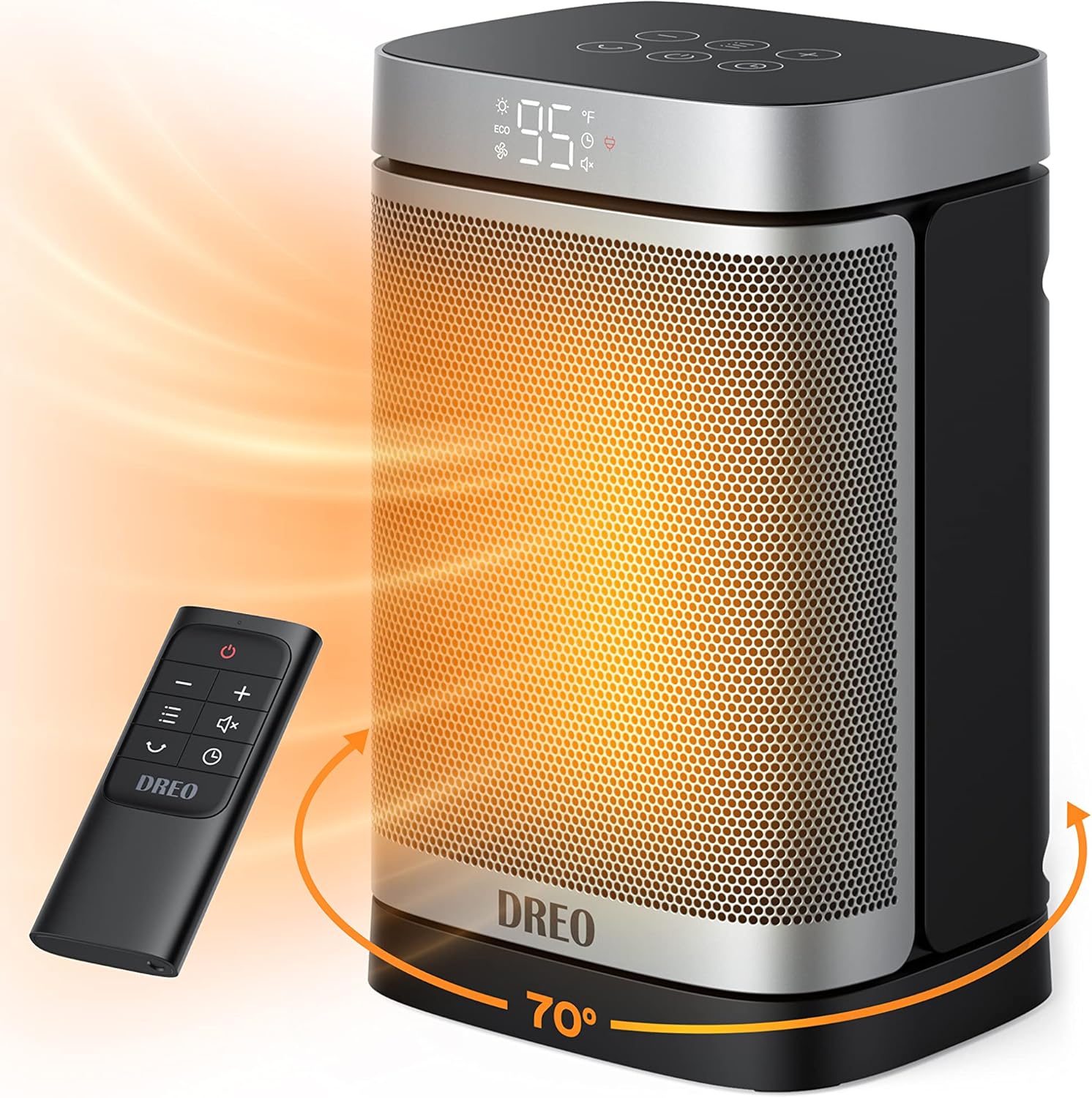
For those looking for an affordable, whisper-quiet heater, go no further than the DREO Atom One.You have to choose between being warm and sleeping because most inexpensive heaters squeak and whistle all nite long. That compromise is terminated by the Atom One.To begin, you may sleep well next to a brushless DC motor that has nine aerodynamic blades because its operating noise level is just 37.5 dB.Secondly, the bedroom is heated evenly throughout thanks to the 70-degree oscillation, which distributes the heat evenly rather than focusing it on a single area.
Lastly, ECO mode allows for automated temperature adjustment to maintain your desired temperature throughout the nite without exhausting the motor.Restrictions to small and medium rooms are caused by its compact size. Overnight, the air can be dried out by fan-forced heat. The plastic body has a feather-light sensation.Ideal for: weak sleepers, studio apartments, one-bedroom apartments, and home offices. Avoid: wide-open floor plans.
5: Lasko 23″ Ceramic Tower Space Heater 751320
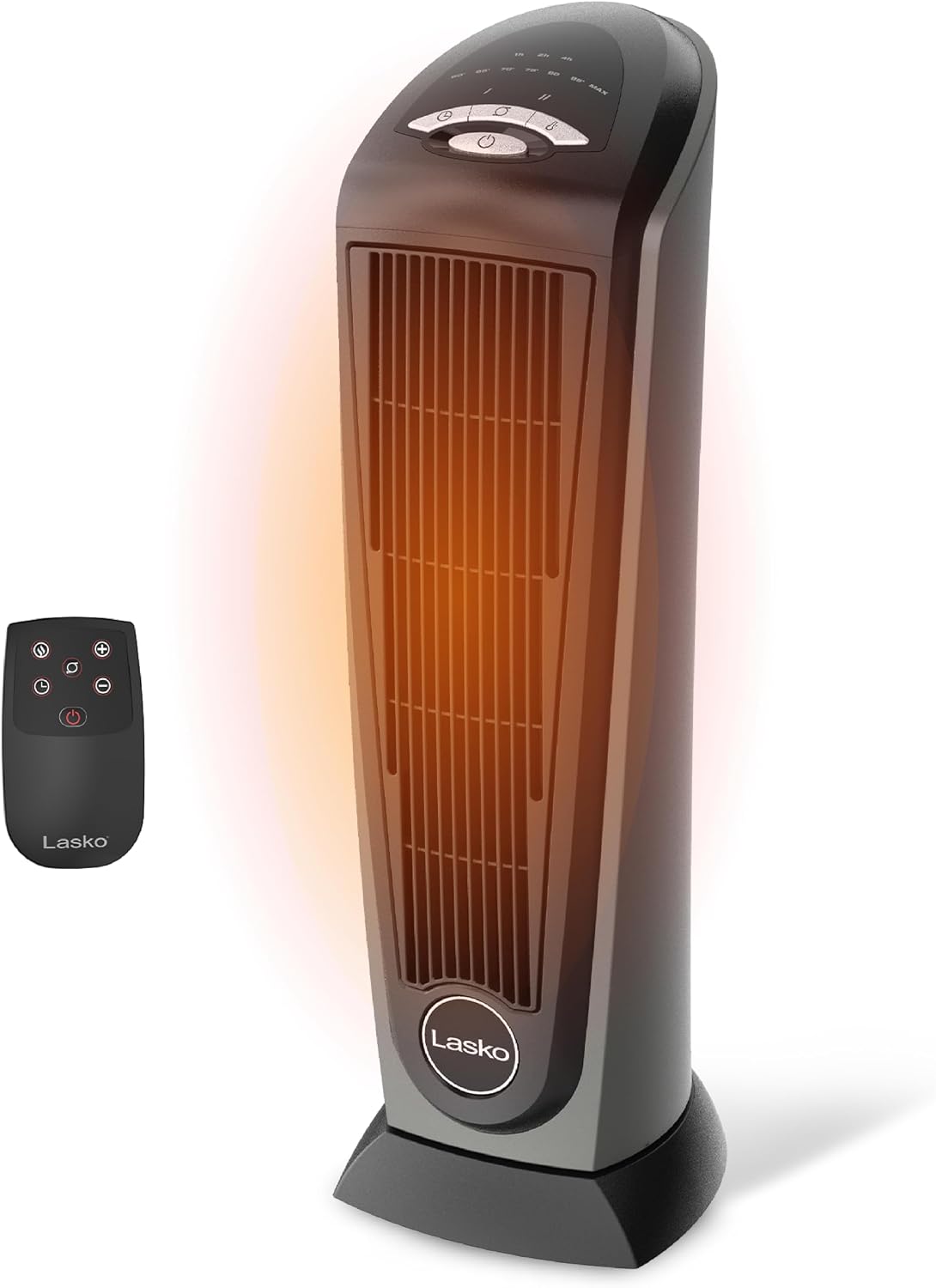
For houses with children and pets, the Lasko Ceramic Tower is the ideal heater that is safest for the whole family.A hot heater is not the place for little hands or wagging tails. For worry-free daily use, the Lasko is ETL-certified and designed for households on the go.To start, you can safely bump into the cool-touch casing, and the overheat protection is always watching.Afterward, a ceramic element that can regulate itself ensures that it never gets too hot to handle.
At last: a 7-hour timer on the remote and extensive oscillation. Remove it from the sofa or bed and leave it to turn off by itself.Thermostat has only two heat settings, which is a drawback. The screen is tiny and unadorned. Even on the highest setting, you can hear the fan.Who it’s best for: pet owners, parents, and living rooms of a medium size. Basements and expansive open floor designs are not suitable.
4: DREO Whole Room Heater, 3D Oscillating

Ensure that every area of your room is warm and toasty with the DREO Whole Room Heater.If you put a heater in front of something, it will only heat that object. The remainder of the chamber remains frigid. It is capable of transporting heat in three dimensions.To start, heat is circulated from the floor to the ceiling through oscillation at 60 degrees vertical and 90 degrees horizontal.After that, heat travels across the room at a speed of 12 feet per second, reaching its destination approximately two seconds after the appliance is turned on.
Lastly, an energy-saving thermostat with a range of 41–95 degrees (within one-degree increments) and a hold function.Downside: compared to a slender tower, the circulator’s design requires more room. Up above, airflow is obvious. With more options than a basic dial heater, there is more to understand.Square rooms with cold corners and living areas are the best options. Do not use if you are in a small room or prefer a fan-free environment.
3: Dr Infrared Heater DR-968 Portable Space Heater

If you need a powerful heater for a basement or large room, go no further than the Dr. Infrared DR-968.Big, drafty basements are no match for small heaters. As you sit down next to one, the room around you remains frigid. The DR-968 is designed to maximize floor space.To begin, a two-stage heating system that uses infrared quartz tubes in conjunction with PTC ceramic to provide even, deep heat throughout huge spaces.
The following item is a 39 dB low-noise blower that operates at high pressure. Discernible yet commanding.Last but not least: a digital thermostat, a 12-hour shut-off timer, a remote control, and wheels for portability. It remains clean thanks to a lifetime filter.Downside: it’s a hefty stair-bender at 19 pounds. Actual floor space is required by the cabinet. It requires its own outlet due to its 12.5 amp consumption.Underneath floors, repurposed garages, and expansive living spaces are ideal. Do not use in: cramped work areas or bedrooms.
2: De’Longhi Oil-Filled Radiator Heater, 1500W

For those who have trouble sleeping due to allergies or light sleep, the De’Longhi Oil-Filled Radiator is the ideal fan-free warmer.All nite long, fan heaters hum, dry the air, and blow dust. An entirely new tack is taken by this radiator.There is absolutely no fan. Without the presence of airborne dust or dehydrated air, sealed oil emits a mild, inaudible heat.The next thing to know is that ComfortTemp can run up to 20% more efficiently than constantly operating the heater at full power thanks to its automated temperature and power balance features.
Last but not least, a thermal slot design improves heat conduction while reducing surface temperature. It’s easy to move about thanks to the built-in handle and snap-on wheels.Drawbacks: oil radiators don’t heat up quickly, but rather in a steady, steady manner.Comparatively, fan heaters are lighter. Optimal for moderately sized rooms.Ideal for: individuals with allergies, bedrooms, or a strong dislike for fan sounds. Not recommended for: wide open areas or sudden spikes in temperature.
1: DREO Smart Electric Wall Heater

With its sleek design and efficient heating capabilities, the DREO Smart Electric Wall Heater is the best heater on the market.Every other heater in this place is floor-mounted, space-hogging, cord-trailing, and requires you to physically go over to make any adjustments. Heat is redirected by the DREO.To begin, a drilling template is provided for wall mounting. Nothing to trip over, and neither children nor pets will be able to do so.Second, you can operate it with a remote, the DREO app, or even your voice with Alexa. Do your best to warm up the room before you even think about getting out of bed.
Thirdly, the ECO mode maintains the temperature you’ve set while the main heat source, an airflow of 11.5 feet per second, warms up an area of around 150 square feet.The fourth advantage is that unlike other heaters, it is resistant to water and flames, making it ideal for use in areas prone to splashes.Mounting requires drilling close to an outlet, which is a drawback. It won’t be able to follow you around after it’s up. Access to smart features requires Wi-Fi configuration.Apt for: studios, one-bedrooms, and smart houses. Renters without drilling skills or those in need of a portable heater should not use this.
Things to Consider Before Buying a Heater:
As chilly temperatures approach, selecting the right heater becomes essential for comfort and efficiency. Evaluating your specific heating needs along with various options on the market is important. Each heater type offers unique features and benefits that can significantly impact both your heating experience and energy bills.
Portable, Space, and Whole-Home Heaters
Portable heaters provide flexibility, allowing you to move them from room to room based on where warmth is needed most. Space heaters are typically designed for individual rooms, effectively heating smaller areas without the need for extensive central heating. Whole-home heaters, on the other hand, are engineered for larger spaces, integrating with existing HVAC systems to maintain consistent temperatures across multiple rooms. Each option caters to different heating needs, making it essential to evaluate the size and layout of your living space.
Electric, Gas, and Other Fuel Options
Electric heaters are often favored for their simplicity and lack of emissions, making them suitable for smaller spaces and easy to install. Gas heaters, meanwhile, can be more cost-effective over time as they usually offer faster heating capabilities and lower operating costs. Alternative fuel options, such as oil or wood, provide different benefits, including greater availability and independence from utility companies. Choosing the right fuel source can significantly affect both efficiency and your long-term energy expenses.
Heating Capacity and Room Coverage
Choosing the correct heating capacity is essential for effective warmth. Units often have a BTU (British Thermal Unit) rating indicating how much heat they can produce. For instance, a space heater with a rating of around 5,000 BTUs can typically heat a room of approximately 150 square feet efficiently. Assess the square footage of your room and match it to the heater’s specifications to avoid under or overheating.
Energy Efficiency and Operating Costs
Focusing on energy efficiency can minimize operating costs over time. Look for heaters that include an Energy Star rating, which signifies better energy performance. For example, a highly efficient electric heater might use about 40% less electricity than standard models, leading to significant savings on monthly bills. Evaluating watts per hour and operational modes will also help you understand long-term expenses.
Safety Features, Ventilation, and Installation
Safety should be a top priority when selecting a heater. Look for features like tip-over protection, automatic shut-off, and overheating protection, which minimize the risk of accidents. Proper ventilation is also crucial, particularly for gas or propane heaters, as it helps prevent harmful fume buildup. Installation requirements can vary; some units may need professional setup, while others are designed for simple, safe home installation.
Match heater output to your space
Understanding your heating needs begins with matching the heater’s output to the size of your space. Assess the square footage of the area you want to heat, then consult the heater’s specifications to ensure it can effectively warm that size. For example, a small room typically requires a heater with an output of around 1,500 watts, while larger spaces may necessitate multiple units or a more powerful heater. Selecting the correct output not only improves comfort but also enhances energy efficiency.
Check running costs, controls, and warranties
Evaluating running costs involves looking beyond the initial purchase price. Investigate the heater’s energy efficiency rating, as this directly impacts your monthly utility bills. Consider models with programmable controls, allowing you to adjust settings based on your schedule, optimizing usage and reducing costs. Additionally, reviewing warranty terms can provide peace of mind; many reputable brands offer warranties ranging from one year to a decade, ensuring long-term support and reliability.
Measure your space and set a budget
Evaluating the dimensions of your space is essential for effective heating. Take accurate measurements of the area, considering ceiling height and insulation quality, which influence heating needs. Next, establish a budget that includes not just the purchase price but also installation costs, taxes, and potential maintenance. Setting a realistic budget upfront will streamline your choices and prevent overspending on features you may not need.
Compare models, safety ratings, and total costs
Evaluating various heater models helps identify the best option for your situation. Look for Energy Star ratings, which indicate efficiency and lower long-term costs. Safety features such as tip-over protection and automatic shut-off mechanisms should also be prioritized, especially in homes with children or pets. Total costs should encompass not only the initial purchase but also ongoing operational expenses, giving a clearer financial picture of your choices.
Confirm installation and maintenance requirements
Understanding installation needs is crucial to avoid complications during setup. Some heaters require professional installation, while others may be DIY-friendly. Verify whether you need additional components, such as vents or wiring upgrades, which might increase costs. Regular maintenance is another aspect to consider; models with replaceable filters or accessible components can simplify upkeep, ultimately saving you time and money in the long run.
Benefits of Different Heater Types
Electric heaters excel in providing instant warmth, making them suitable for spot heating or smaller living areas. Oil-filled radiators maintain warmth for extended periods, enhancing comfort during colder months. Gas heaters deliver efficient heating and can often be tied to a home’s existing gas line, reducing installation complexity. For larger homes, heat pumps not only heat but can also cool spaces, offering year-round functionality despite their higher initial costs.
Common Limitations and Potential Costs
Increased energy bills often result from the usage of electric heaters, especially in larger homes where heating multiple rooms can lead to skyrocketing expenses. Gas heaters can incur installation costs, particularly if venting or gas lines are necessary. Furthermore, maintenance for certain heater types, such as gas, may involve regular inspections, which add to ongoing costs. Understanding these potential limitations empowers you to choose wisely based on your specific needs.
To wrap up
Before making a heater purchase, reflect on your specific needs, including the size of your space and desired heating capacity. Evaluating energy efficiency will also play a vital role in reducing long-term costs. Consider any additional features, such as programmable thermostats or remote controls, that enhance usability. Researching brand reputations can help ensure a reliable choice, while warranty options provide peace of mind. Taking these steps will lead to a more informed and satisfactory heater purchase.
Leave a Reply