
Finding the best motorcycle helmets doesn’t have to be a headache. You deserve ultimate crash protection that keeps you comfortable on every mile. We analyzed top-rated riding gear to bring you options that truly save lives while looking great. Protect your head and embrace the freedom of the open road with these fearless choices. Ready to find your perfect fit? Let’s look at the winners.
Contents
- Top 5 Motorcycle Helmets:
- 1. Shoei RF-1400 – Best Motorcycle Helmet Overall
- 2. Shoei GT-Air II – Best Premium Sport-Touring Motorcycle Helmet
- 3. ILM 902BT – Best Flip-Up Motorcycle Helmet with Integrated Speakers & Mic
- 4. Bell Qualifier – Best Commuter Full-Face Motorcycle Helmet for Daily Use
- 5. ILM 317 Full-Face – Best Budget Motorcycle Helmet
- Things to Consider Before Buying a Motorcycle Helmet:
- Full-Face Helmets
- Modular Helmets
- Open-Face Helmets
- Half Helmets
- Safety Ratings
- Fit and Comfort
- Weight and Aerodynamics
- Maintenance and Care
- Adjusting Straps and Padding
- Final Fit Check
- Common Concerns
- Myths Debunked
- Final Words
Top 5 Motorcycle Helmets:
1. Shoei RF-1400 – Best Motorcycle Helmet Overall

The Shoei RF-1400 is an excellent choice for a full-face helmet if you value comfort, silence, and protection. It has a small, lightweight design that has evolved from a reliable lineage, making it easier to wear on longer rides and daily commutes without causing neck strain.You’ll love the serene sensation when you’re moving quickly. You can now concentrate on your line and the road ahead thanks to the reduced wind and road noise made possible by the improved shell aerodynamics and the brand new airtight shield system. To achieve a happy medium between cooling and a quieter interior, the vent channels are strategically arranged to direct airflow over your scalp and through the liner.
Comfortable and snug fit for riders. The shield mechanism makes opening, shutting, and cleaning a breeze, and the inside padding provides all-around support for your jaw and crown. The RF-1400 has emergency-release cheek pads, so first responders can take it off more quickly in case they need to. This gives you peace of mind.
The compact shell shape and smooth Basalt Grey surface aren’t merely aesthetic touches; they contribute to the reduction of buffeting and improvement of stability. A helmet that changes with your riding style is one that is compatible with a wide variety of inserts and communications systems, including the widely used Pinlock system.
When looking to upgrade your helmet, the Shoei RF-1400 is a great choice because it combines long-distance comfort, minimal noise, and good impact management. You may confidently ride it for commuting, touring, or weekend canyon carving.
2. Shoei GT-Air II – Best Premium Sport-Touring Motorcycle Helmet

The Shoei GT-Air II is an excellent choice if you’re looking for a high-quality sport-touring helmet that will keep your head cool, silent, and comfortable for an extended period of time. Its aerodynamic shell makes long rides more bearable by dampening wind noise and turbulence, allowing you to maintain concentration and energy levels. Additionally, the helmet has great ventilation, with three intake vents and five exhaust vents directing airflow through it to keep you cool in hot weather and quiet inside.
The Multi-Ply Matrix AIM shell and multi-density EPS liner of these shoes from Shoei effectively regulate impact energy while keeping the weight acceptable at roughly 3.64 pounds, ensuring that your neck and shoulders will feel better after a long day. On the inside, you’ll find 3D Max-Dry System II pads that absorb sweat, preserve their form for a snug but comfortable fit, and are machine washable for long-term freshness.
It is also quite easy to use on a daily basis. Fuel stops and gear changes are made easier with a glove-friendly micro-ratchet chin strap that provides rapid and secure closure. With an integrated sun visor, you can adjust to changing lighting conditions without removing the shield. It improves visibility and reduces glare.
Whether you’re commuting or touring on the weekend, the GT-Air II will make your ride easier, quieter, and more controlled thanks to its rider-focused ergonomics, premium materials, and efficient ventilation. It also has all-day comfort and low noise levels, which are important to you.
3. ILM 902BT – Best Flip-Up Motorcycle Helmet with Integrated Speakers & Mic
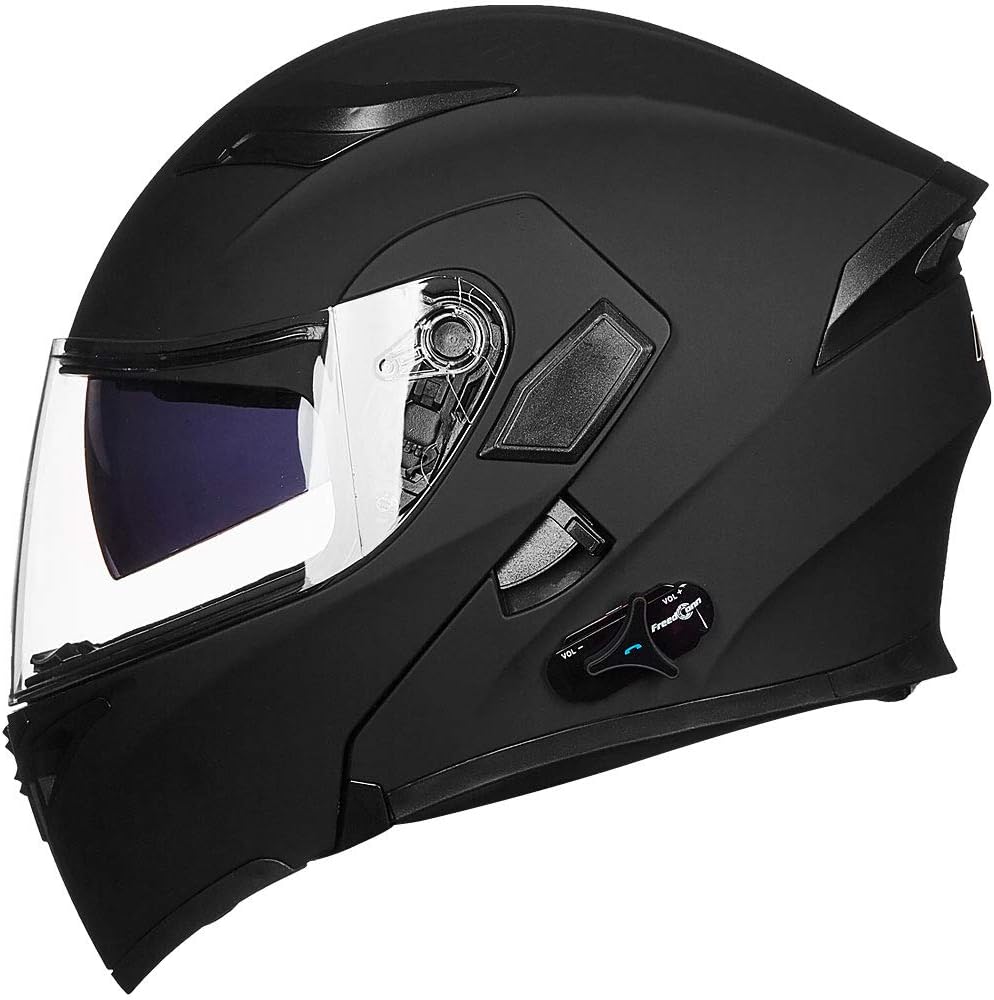
The ILM 902BT is a great flip-up helmet if you’re looking for a way to stay connected while riding without adding unnecessary complexity. On longer rides, you’ll appreciate the airflow system and the removable liners that keep you cool and comfortable. The durable ABS shell with a dual-visor configuration ensures clear vision in bright sun or at night. For everyday street use, touring, and adventure, its 1.94 kg weight strikes a good mix between protection and wearability.
With the integrated Bluetooth 3.0, you can manage your calls, music, FM radio, and GPS instructions with easy, glove-friendly taps. Keep your eyes on the road and your voice audible thanks to the built-in speakers and noise-cancelling microphone.Traveling in a group? With a practical range of up to 500 meters (1,640 feet), the intercom is useful for lane changes, fuel stops, and rapid route updates. It can couple up to three helmets and offers two-way talk for two riders simultaneously.
Up to twelve hours of conversation time on the phone, eight hours on the intercom, and one hundred and ten hours on standby—that’s a lot of power for actual journeys. When not in use for an extended period of time, the device goes into deep sleep to conserve power; to wake it up, simply plug it in for around 30 minutes.Get the matte black finish for a more confident, comfortable, and communicative ride.
4. Bell Qualifier – Best Commuter Full-Face Motorcycle Helmet for Daily Use

The Bell Qualifier is an excellent choice for commuters looking for a reliable full-face helmet. By combining an EPS impact lining with a lightweight and durable outer shell, you can reduce the overall weight of the product to around 3.5 pounds, which will help alleviate strain on your neck and shoulders caused by prolonged periods of sitting in traffic or on the highway.
On congested streets, you will value unobstructed eyesight. The helmet comes with a transparent NutraFog II face shield that helps prevent fogging and scratching. You can quickly and easily switch shields with Bell’s ClickRelease technology whenever the light changes, so you can get back on the road without any hassle.
If you’re trying to stay cool and focused in a hot city, the Velocity Flow Ventilation system is a great investment. The removable and washable comfort lining allows you to keep your saddle fresh for all riding seasons with its snug fit and absence of hot spots.
Smooth shield movement, easy maintenance, and materials selected for durability (including polyester components where applicable) are all examples of everyday practicality in action. You won’t think twice about taking this helmet for all your errands, from brief trips to the office.The Bell Qualifier provides the assurance and comfort you need for every ride with its commuter-friendly design, dependable airflow, and quick shield adjustments.
5. ILM 317 Full-Face – Best Budget Motorcycle Helmet

The ILM 317 Full-Face helmet provides reliable protection without sacrificing quality, making it an excellent choice for those on a tight budget. The combination of a high-density EPS liner and a durable ABS outer shell allows it to effectively handle impact forces, meeting or exceeding both DOT and FMVSS-218 safety standards. Its 2.22 kg weight makes it strong but controllable, making it ideal for casual off-road riding or everyday commutes on street bikes.
The immediate improvement in comfort is guaranteed. On hot commutes or longer weekend rides, Comtex liners’ ultra-soft, stretchy, moisture-absorbing fabric will keep you dry. You can clean the inside and keep it in better shape over time thanks to the detachable and washable pads. When you’re on and off the bike a lot, a sturdy quick-release strap will come in handy because it makes getting on and off the bike a breeze.
In order to keep the wearer cool without increasing noise-inducing turbulence, the helmet’s aerodynamic shell and multi-vent system manage airflow.
When properly sized, the 317’s internal shapes will provide solid, hot-spot-free support for your crown and cheeks, ensuring your safety and comfort. Investing in the ILM 317 is a wise move if you want a trustworthy, easy-to-live-with full-face that provides all-day comfort, protection, and affordability.
Things to Consider Before Buying a Motorcycle Helmet:
Helmet choice affects your safety, comfort, and riding experience, so you should assess fit, safety ratings, helmet type (full-face, modular, open-face), shell material, retention system, ventilation, noise levels, and compatibility with eyewear and communication devices. Try helmets on to confirm proper fit, check DOT/ECE/SNELL certifications, consider weight and padding, and balance protection with comfort and visibility to ensure your helmet serves you well on every ride.
Full-Face Helmets
You get the highest facial and cranial protection with full-face helmets; many riders choose models like Arai or Shoei that meet DOT/ECE/Snell and weigh 1200-1700 g, feature multi-density EPS and effective ventilation, and provide a sealed visor to reduce wind noise-ideal for highway speeds and sport riding where impact and aerodynamic stability matter most.
Modular Helmets
You benefit from a flip-up chin bar that lets you talk, eat, or clear fog without removing the helmet; expect modulars to be roughly 100-200 g heavier than similar full-face models and watch for quality of the hinge and locking mechanism, since those parts influence noise, fit, and whether the helmet achieves full-face-level certification when closed.
You should inspect the latch engagement and hinge wear periodically, lubricate pivot points per manufacturer guidance, and test visor sealing at speed-models like the Schuberth C4 or Nolan N100‑5 illustrate that high-end modulars can approach full-face comfort and aero performance when well designed, but cheaper units often sacrifice seal and structural stiffness.
Open-Face Helmets
You gain improved situational awareness with open-face helmets thanks to wider peripheral vision and better hearing, making them popular for urban commuting and low-speed cruising; however, they leave your jaw exposed, so pairing with an optically correct face shield or goggles is important for debris and wind protection when you ride above city speeds.
You should evaluate visor options and the helmet’s wind turbulence at 30-60 mph; many open-face users add drop-down visors or anti-fog inserts, and shell construction varies from thin ABS to composite blends-choosing a well-padded liner and good retention system helps reduce wind lift and improves comfort on longer urban runs.
Half Helmets
You get the lightest option with half helmets-often 700-1100 g-which appeals for short, low-speed rides and a minimalist look, but they provide limited impact coverage and almost no facial protection, so you should pair them with goggles and accept higher wind noise and less weather protection than other types.
You should check strap systems (D-ring vs quick-release), liner replacement availability, and legal requirements in your area; half helmets can be fine for slow, local cruising, yet they are inappropriate for high-speed highways or off-road where facial and chin protection significantly alter injury outcomes.
Safety Ratings
You should look for DOT (FMVSS 218) in the U.S., ECE 22.06 in Europe and Snell M2020/M2025 where applicable; ECE 22.06 adds oblique-impact testing to measure rotational acceleration while Snell typically enforces higher-energy linear-impact limits. A helmet that carries two certifications (for example DOT plus ECE) often offers broader protection across test regimes, and always verify the label inside the shell.
Fit and Comfort
Measure your head circumference in centimeters and match the manufacturer’s sizing chart, then test for even pressure around the crown and firm cheek-pad contact without pain; a properly sized medium (57-58 cm) should hold steady when you shake your head. Try round, intermediate and long-oval shells since shape, not just size, dictates long-term comfort for your riding profile.
Perform the roll test by fastening the chin strap and sliding two fingers between strap and jaw, then attempt to roll the helmet off – it shouldn’t slip; check for pressure points after 10-15 minutes and note how liners compress, as foam can pack out over months. Replace or swap cheek pads to adjust fit, consider seasonal liners (thicker for winter), and prefer a Double-D or automatic retention system tuned to your jaw shape for secure retention on impact.
Weight and Aerodynamics
Expect average full-face helmets to weigh between 1,300-1,700 g; premium carbon shells can drop to 1,100-1,300 g, reducing neck fatigue on multi-hour rides. Aerodynamic features like integrated spoilers and tapered tails cut buffeting at high speed – racers and sport riders will notice stability gains above 160 km/h – while touring riders should prioritize low-wind-noise designs with good chin-bar flow.
Shell profile and center-of-mass matter: a heavier chin bar increases rotational inertia and can tire your neck faster, while a rear spoiler tuned in a wind tunnel reduces lift and yaw at speed. Manufacturers use multi-density EPS to tune energy absorption without adding weight; if you ride sustained highway distances, choose a helmet that balances a lighter composite shell with effective noise seals and vents to minimize fatigue and maintain visual stability at speed.
Maintenance and Care
Clean the visor using mild soap and a microfiber cloth, remove liners for hand-washing per the manufacturer’s instructions, and always air-dry away from direct heat. Inspect straps and EPS liner for wear or compression, replace the helmet after a significant impact or generally every five years depending on exposure to UV, sweat and frequent use.
Use only approved cleaners or mild detergent-avoid solvents and petroleum products that degrade EPS and coatings. Store helmets in a cool, dry place or breathable bag, replace scratched visors (optical clarity matters), check fasteners on removable vents and visors regularly, and rotate helmets if you ride daily to extend service life.
Adjusting Straps and Padding
Fasten the chin strap using the system supplied (D-ring or quick-release) so you can fit two fingers between strap and chin; ensure cheek pads press snugly against your face without creating hotspots, and confirm the helmet remains level, not tipping forward or back.
For finer tuning, swap or add manufacturer liners to adjust lateral fit by 5-10 mm increments; when threading a D-ring, loop the strap through both rings then back through the first to lock-tighten until the helmet resists downward pull by about 1-2 cm without causing pain. Test by opening your mouth wide: properly seated cheek pads will pull the helmet slightly downward, indicating correct tension; if you feel pressure points after 10-20 minutes, try a different model or a replacement liner.
Final Fit Check
Perform a roll test by holding the helmet and trying to slide it off forward and back-movement should be minimal (~1-2 cm); then do head-shake and nod tests to ensure stable fit, verify clear peripheral vision, and confirm straps don’t chafe during simulated motion.
After a short ride or 15-30 minutes of wear, reassess for pressure hot spots and strap comfort; check visor alignment and that the helmet’s field of view meets your needs (many modern helmets deliver ~190-210° horizontal vision). If the helmet shifts during aggressive head movement or causes numbness, try another size or shell shape-fit varies between brands and even between models within a brand.
Common Concerns
If you worry about comfort, noise, or fogging, prioritize fit and features: full-face helmets typically weigh 1.2-1.6 kg and should hold cheeks snugly without pressure points; reduce fogging with a Pinlock or double-pane shield and active vents; cut wind noise by eliminating gaps around the neck roll and ensuring a proper jawline seal; try helmets for 10-15 minutes on-road to validate ventilation and pressure distribution.
Myths Debunked
You may hear that expensive equals safer or that full-face helmets block hearing-those aren’t reliable rules: certification matters more than price, and properly fitted full-face helmets preserve situational hearing while offering better impact protection; multiple studies estimate helmets reduce fatal head injury risk by roughly 37%, so functional standards and fit beat branding alone.
For more detail, consider that Snell standards prioritize higher-energy impacts typical of track crashes, while ECE 22.06 adds oblique-impact and rotational criteria relevant to street accidents; DOT enforces baseline U.S. requirements focused on impact attenuation and retention. You should match the standard to your riding-track riders may favor Snell-rated shells, commuters benefit from ECE/DOT models with proven oblique performance-and always discard helmets with compromised EPS, cracked shells, or damaged straps.
Final Words
Taking this into account, you should prioritize certified protection, proper fit and comfort, clear visibility, adequate ventilation, and appropriate helmet type for your riding style; try several sizes, check weight and noise levels, inspect visor options and retention systems, and verify maintenance and replacement policies so you select a helmet that protects your head without compromising comfort or control.
Leave a Reply